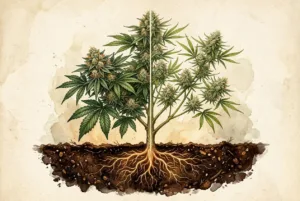
It’s week five, you’re in the grow tent, and small bumps are showing at the joints where the branches meet the stem. You can’t tell whether you’ve got a male marijuana plant or a female.
Check the nodes, where each branch meets the main stem, starting a few sets up from the bottom. A small, round, hairless sac means male. A pointed teardrop with wispy white hairs means female.
One male that opens its pollen sacs can seed an entire crop, and you can’t take that pollen back. Catch it at the pre-flower stage instead, usually between weeks 3 and 6. At week five, you’re inside that window.
Here’s when to look, what to look for, and what to do the moment you find one.
Why Growers Pull Male Plants Before They Flower
Female plants grow the dense, resinous flowers people want to smoke. Males don’t. A male marijuana plant puts its energy into stalk and pollen sacs, and it never grows a smokable bud.
The damage comes from what a male does to the females. A pollinated female stops growing bigger buds and starts making seeds. That leaves you with seedy buds, harsher smoke, and lower quality.
That’s why growers prize sinsemilla, Spanish for “without seed.” It’s what you get when females never get pollinated and put all their energy into flower. The only fix is spotting the male before it releases pollen, and the earliest sign shows up at the nodes.
The Earliest Sign: Pre-Flowers at the Nodes
Pre-flowers are the tiny first flower structures a plant forms at its nodes, weeks before it starts flowering for real. They’re how you tell a male or female marijuana plant apart this early.
When to Look
Pre-flowers usually appear between weeks 3 and 6, depending on genetics. Some plants show early and others make you wait. Don’t relax just because week four passed with nothing to see.
Where to Look
Look at the nodes, where each branch meets the main stem. Start a few sets up from the bottom and work your way up, checking every branch.
What to Look For
So what does a male marijuana plant look like at the nodes? Here’s how it compares with a female.
- Male pre-flowers are small, round, and ball-like, with no hairs. Picture a tiny green bead tucked into the joint.
- Female pre-flowers are pointed and teardrop-shaped, with thin white hairs (pistils) coming out of the tip. Picture a tiny green teardrop with whiskers.
Both are tiny, often just a couple of millimeters across, and early on a female may show only a wisp or two of hair. Look closely before you call it.
How to Check
To tell a male marijuana plant from a female this early, you need magnification.
- Use a 30–60x jeweler’s loupe or a phone with a macro lens.
- Check every day. Once pollen sacs form, they can open within days.
- Work in good light, handle the plant gently (rough handling stresses it), and photograph the same node each day so you can compare instead of relying on memory.
Speeding It Up
How you do it depends on what you’re growing.
- Photoperiod plants flower in response to the light schedule. Switching to a 12/12 schedule (12 hours of light, 12 of darkness) for a week or two forces pre-flowers to show. Only do this if you’re ready to flower the females. If nothing shows after two weeks, give it a few more days, because some genetics are slow.
- Autoflowers flower on their own after a set age, so they need no light change. Just keep looking.
READ: What Does Weed Smell Like?
When the Male Plant Fully Shows Itself
If you miss the pre-flower stage, a male marijuana plant announces itself with pollen sacs. Pre-flowers mature into clusters of small sacs hanging from short stalks, like bunches of tiny grapes. At first they’re green and firm, and they can start out hidden under the big fan leaves.
Within a few days to about two weeks, the sacs split open and release fine yellowish pollen. That’s the point of no return. Pollen rides the air, clings to clothes and tools, and finds every female in reach.
If the sacs are already open, go straight to “Found One? Do This Next,” and watch nearby females for seeds once they flower.
Waiting for the sacs to confirm what you suspect is how grows get ruined. If you can’t tell yet, gently move the plant away from the others, bagging it first if any sacs are forming, and keep checking it there.
Whole-Plant Clues (and Why Not to Trust Them Alone)
Step back from the nodes, and the plant itself can drop hints. Male marijuana plants are often taller and lankier than females, with sparser foliage and wider spacing between nodes. If one plant is stretching past its siblings like it’s reaching for the sun, give it a closer look.
But be honest with yourself: this varies by strain and growing conditions. Sativa-leaning plants naturally stretch more than indica-leaning ones (if you want the genetics side of that, the Indica vs. Sativa guide covers what actually matters). A plant crowded for light will stretch no matter its sex. And plenty of males look just like their sisters until the nodes say otherwise.
Use these clues to send you back to the nodes. Never use them in place of checking the nodes. Identifying male marijuana plants by height or foliage alone is how people pull the wrong plant.
When a Female Isn’t Fully Female: Hermaphrodite Plants
A plant that started out female can grow male parts later. Growers call it a hermaphrodite, or a “hermie.”
It usually comes down to stress, like light getting in during the dark hours, heat, rough handling, or waiting too long to harvest. Some plants are also prone to it because of their genetics.
Look for two things.
- Nanners are small, yellowish, banana-shaped growths that poke out of the buds. They’re the male parts that make pollen.
- Stray pollen sacs are small, round sacs tucked into or sticking out of the flowers.
Check every few days through the flower, and look closer in the final weeks. Part the buds and look deep inside, since both can hide there.
What you do depends on what you find:
- Closed and few: If the nanners or sacs are still closed, remove them right away. Gently pluck them into a bag so nothing scatters, then check that plant daily, since more can follow.
- Open or shedding: If anything has opened, or you see yellow dust, treat the plant like a male and follow “Found One? Do This Next.”
Can you still smoke a hermie plant? Yes, if the buds haven’t been pollinated, since it’s still flower from a female plant. Seeds are the catch, and they show up once pollen has done its work.
Found a Male Marijuana Plant? Do This Next
Do these in order, and do them today.
- Act immediately. Closed sacs mean you have a little time. Open sacs mean you have none. Don’t wait for the weekend.
- Shut off the airflow, then bag it. Turn off fans first so nothing pushes pollen around. Slide a large bag over the whole plant, gently, and tie it off at the stem before you cut or lift it. No shaking, and no dragging it through the rest of the grow.
- Take it far away. Get it out of the grow area and well away from anywhere pollen could blow back, not just the next room over. Dispose of it far from your plants, and don’t leave it sitting in an open pile.
- Clean up everything it touched. Wipe down scissors, trays, pots, surfaces, and the floor, then wash your hands and change your clothes. Pollen is fine and sticky, and it hitchhikes.
- Check every remaining plant. Go node by node on each one, then do it again in a few days. Others may not be showing their sex yet. If you started from regular seed, expect roughly half your plants to turn out male, so this may not be the last one.
The one exception. Breeders sometimes keep a male on purpose as a pollen source, well away from anything meant for smoking. If you’re thinking of keeping one “just in case,” don’t.
Is a Male Plant Good for Anything?
Can you smoke a male marijuana plant? Technically, you can, but it isn’t worth it. Do male marijuana plants have THC? Only trace amounts of cannabinoids, far less than a flowering female, and the material is harsh to smoke. Expect an unpleasant smoke for very little payoff.
Here’s what growers actually do with a male instead:
- Breeding. Pollen from a chosen male is how new seeds get made, as a deliberate, separate project.
- Fiber-type uses. The stalks contain fibers, and some growers and crafters put them to work.
- Compost. Chop it up and add it to the pile, well away from your grow.
- Low-potency experiments. Some growers play around with leaves and trim in low-potency projects, but keep your expectations modest.
Mostly, though, a male is a plant you grew by accident, and the most useful thing you can do about one is protect the rest of your plants.
Check Your Nodes This Week
Grab a loupe or a macro lens, go node by node, and keep checking until you’re sure about every plant. A single day matters here.
And if you’d rather skip the grow, whether you lost a crop to pollen or just don’t want the worry, browse the NorCal Holistics Sacramento delivery menu for licensed, lab-tested flower.
NOTE: This article is for general educational purposes only and is not legal advice. Cannabis remains illegal under federal law, and state and local rules can change. NorCal Holistics is a state-licensed cannabis delivery service serving the Sacramento area (License C9-0000013-LIC).
Frequently Asked Questions
Do male marijuana plants produce buds?
Not any worth smoking. Instead of flowers, a male grows clusters of pollen sacs.
Do male marijuana plants produce seeds?
No. Seeds only form when a male’s pollen reaches a female flower.
What does a female marijuana plant look like?
Early on, you’ll see pointed, teardrop-shaped pre-flowers with thin white hairs at the nodes. Later, those develop into dense, resinous buds. The full male vs. female contrast is in “The Earliest Sign: Pre-Flowers at the Nodes.”
Can a male plant turn female?
No. A male stays male. What looks like a switch is usually a hermaphrodite or a plant that was misidentified in the first place.
Can you still smoke a hermie plant?
Often, yes, if the buds haven’t been pollinated. Seeds and lower quality are the catch. The full answer is in the hermaphrodite section above.
How many marijuana plants can you grow at home in California?
Up to six per private residence for adults 21 and over, but local rules can restrict or ban outdoor grows, and renters need landlord permission. Check your city or county first.